AI + Human Expertise: How to Create Content That Ranks in 2026
Discover how to combine AI tools with human expertise to create high-ranking content in 2026. Learn proven strategies, workflows, keyword tactics, and quality frameworks used by top SEO professionals

The Content Arms Race Has a New Weapon — But It Needs a Human Trigger
The rules of SEO have changed more dramatically in the last 18 months than in the previous decade combined. Google's Helpful Content System, the rise of AI Overviews (formerly SGE), and the mass proliferation of AI-generated articles have reshaped what it takes to rank on Page 1.
Here is the uncomfortable truth most content agencies won't tell you: AI alone does not rank. Humans alone can't scale. But together, they can dominate.
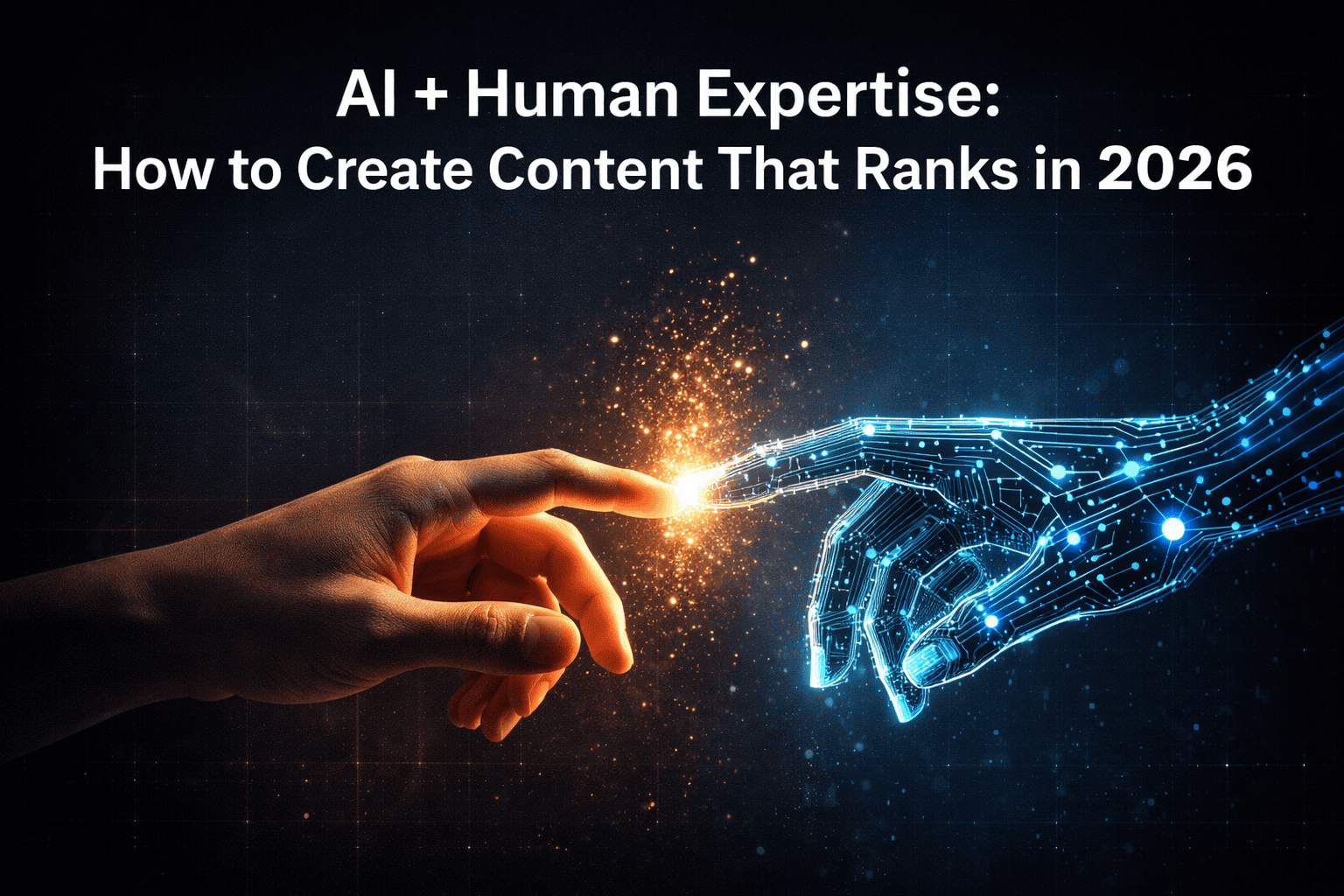
In 2026, the highest-performing content on the web is not written purely by humans, nor is it generated wholesale by an LLM and published raw. It is the product of a deliberate, disciplined collaboration — one where AI handles velocity, structure, and data synthesis while human experts inject authority, nuance, lived experience, and strategic judgment.
This guide breaks down exactly how that collaboration works, what Google's current algorithms reward, which AI tools are worth using, and how to build an editorial workflow that produces content that ranks, converts, and builds lasting topical authority.
Whether you are a solo content creator, an in-house SEO manager, or a digital agency scaling output for dozens of clients, the frameworks here will give you a clear, actionable roadmap for 2026 and beyond.
Author
Yehor Masiuk — Founder of Adprofit.io and a performance marketing specialist focused on Google Ads, Meta Ads, and AI-driven marketing strategies.
He helps companies scale customer acquisition through paid advertising, data-driven growth strategies, and high-performance marketing systems. Yehor works with international clients across SaaS, e-commerce, and service industries.
LinkedIn:
https://www.linkedin.com/in/yehor-masiuk-ads
Part 1: Understanding the 2026 Search Landscape
How Google Evaluates Content in 2026
Before building any content strategy, you need to understand what Google's ranking systems are actually measuring. The algorithm has evolved far beyond keyword matching. As of 2026, Google's core evaluation framework can be summarized around three pillars:
- E-E-A-T (Experience, Expertise, Authoritativeness, Trustworthiness) — Google's Quality Rater Guidelines place enormous weight on whether content demonstrates real-world experience. A travel article written by someone who actually visited the destination outranks a synthetically generated listicle, even if both are technically accurate.
- Helpfulness Signals — Following the Helpful Content Updates, Google evaluates whether a piece of content satisfies user intent completely, or whether searchers are bouncing back to the SERP to find a better answer. Dwell time, scroll depth, and return-to-SERP rates all function as indirect quality signals.
- Topical Authority — A site that covers a subject comprehensively, with interlinking content clusters across subtopics, consistently outperforms sites with isolated, unrelated articles. In 2026, topical authority is the moat.
Key Insight: Google is not penalizing AI-assisted content. It is penalizing low-quality content — content that is generic, unverifiable, or fails to add genuine value. The origin of the content (human or AI) matters far less than its usefulness.
The Rise of AI Overviews and Zero-Click Searches
Google's AI Overviews (rolled out broadly in 2024–2025) pull synthesized answers directly into the SERP, reducing click-through rates for informational queries. This has fundamentally shifted what "ranking" means:
- Position 1 for a navigational or transactional query still drives significant traffic.
- Featured snippet / AI Overview source for informational queries is the new gold standard — your content must be structured to be cited, not just ranked.
- Long-tail, high-intent queries remain highly click-worthy because AI Overviews struggle to satisfy nuanced, specific, or experience-dependent queries.
The implication: Content strategy in 2026 must target a mix of AI-Overview-optimized structured content (to get cited as a source) and deep, experience-rich long-form content (to capture traffic AI Overviews cannot satisfy).
Part 2: The Human-AI Content Model — A Framework for 2026
Why Pure AI Content Fails
Let's be direct about what large language models cannot do, no matter how sophisticated:
- Verify facts in real time — LLMs trained on historical data cannot report breaking industry news or recent case studies.
- Provide original research — They synthesize existing information; they cannot run surveys, conduct interviews, or produce proprietary data.
- Express genuine opinion with accountability — An LLM can simulate opinion, but Google and readers sense the difference between stated perspective and authentic voice.
- Build brand trust — Readers who discover an article was written entirely by AI with no human review lose trust in the publisher.
Why Pure Human Content Cannot Scale
On the other hand, even the best human writers face unavoidable limitations:
- Speed — A skilled writer might produce one polished 2,500-word article per day. At that rate, building a 200-article content cluster takes nearly a year.
- Consistency — Maintaining consistent tone, internal linking structure, and keyword strategy across dozens of pieces is cognitively demanding.
- Research breadth — Synthesizing information from 40 sources takes hours; an AI can do it in seconds.
The Optimal Collaboration Model: HAIS (Human-AI Integration Stack)
The most effective content operations in 2026 follow a structured workflow that assigns tasks by comparative advantage:
| Stage | AI Role | Human Role |
|---|---|---|
| 1. Strategy & Research | Generate keyword clusters, identify content gaps, analyze SERPs | Validate priorities, apply business context, identify unique angles |
| 2. Outline Creation | Draft H2/H3 structure based on SERP analysis | Refine outline, add proprietary insights, restructure for narrative flow |
| 3. First Draft | Generate initial body copy at speed | N/A at this stage |
| 4. Expert Layer | N/A | Add personal experience, quotes, case studies, original data, opinion |
| 5. Editorial Review | Grammar/style pass, SEO compliance check | Fact-check, brand voice alignment, final judgment on quality |
| 6. Optimization | Internal linking suggestions, meta generation, image alt-text | Approve, adjust, publish |
This model is sometimes called the "AI as Apprentice, Human as Editor" approach — and it consistently outperforms either pure-AI or pure-human workflows on both quality and efficiency metrics.
Part 3: The AI Tools That Actually Move the Needle in 2026
Category 1: Research and Keyword Intelligence
Effective AI-powered research does three things: identifies what users actually want, surfaces the questions competitors haven't answered, and maps keyword clusters that build topical authority.
Top tools in this category include:
- Semrush's AI Writing Assistant + Keyword Magic Tool — Combines keyword research with on-page optimization scoring. Particularly strong for identifying semantic keyword clusters.
- Ahrefs Content Explorer with AI Summaries — Helps identify content gaps by showing what top-ranking articles cover and what they miss.
- Perplexity AI for Research Synthesis — Excellent for generating a structured research brief quickly, especially for technical or niche topics.
- Google's "People Also Ask" + AlsoAsked.com — Still one of the most powerful free tools for understanding the full question landscape around any topic.
Pro Tip: Before writing a single word, use an AI research tool to generate a list of at least 30–40 related questions around your primary keyword. This ensures your content achieves true topical depth rather than surface-level coverage.
Category 2: Content Generation and Drafting
Not all AI writing tools are equal. The key differentiator in 2026 is not raw output quality but controllability — how precisely you can direct the AI to match your brand voice, expertise level, and structural requirements.
Recommended tools by use case:
| Use Case | Recommended Tool | Strength |
|---|---|---|
| Long-form SEO articles | Claude 3.5 / GPT-4o | Nuanced instruction-following, coherent long-form |
| Product descriptions at scale | Jasper AI | Template-based, brand-voice trained |
| Technical documentation | GitHub Copilot + Claude | Code-aware, technical accuracy |
| News and timely content | Perplexity AI | Real-time web access |
| Multilingual SEO | DeepL Write + Claude | High translation quality with semantic preservation |
Category 3: SEO and Optimization Tools
Once a draft exists, AI-powered optimization tools audit it against top-ranking competitors and suggest improvements:
- Surfer SEO — Analyzes NLP terms, heading structure, and word count relative to SERP competitors. The Content Score metric gives a reliable benchmark.
- Clearscope — Particularly strong for semantic keyword coverage; its "grade" system is a useful quality gate before publishing.
- RankIQ — Excellent for bloggers and small publishers; offers pre-built content briefs with a targeted word count for ranking.
Part 4: Writing for E-E-A-T — The Human Layer That AI Cannot Fake
What "Experience" Actually Means in Content
Google's addition of the first "E" (Experience) to E-A-T in December 2022 was a signal that has only grown stronger. Experience means demonstrating that the author or publisher has actually done the thing they are writing about.
Concrete ways to demonstrate experience in your content:
- First-person accounts — "When I tested this tool across three client campaigns over 90 days, here's what I found..."
- Original screenshots and data — A screenshot of your own analytics, your own tool dashboard, or your own test results is worth more than any stock image.
- Specific, verifiable details — Exact dates, real numbers, named people, and specific locations signal lived experience.
- Failure stories — Counterintuitively, describing what didn't work is a strong trust signal. AI-generated content almost never includes failures.
- Opinions with reasoning — Taking a clear stance and defending it with evidence is something an LLM won't do authentically.
Building Author Authority
In 2026, bylines matter more than ever. Google's systems evaluate author entity signals as part of page quality assessment. Every author contributing to your site should have:
- A detailed author bio with credentials, years of experience, and links to external profiles (LinkedIn, industry publications, conference speaking credits).
- A consistent publishing history on your domain and on other authoritative sites.
- Social proof — Twitter/X, LinkedIn, or industry forum presence that corroborates their claimed expertise.
- Original quote attribution — When AI-drafted content is reviewed and enriched by a named expert, that expert's voice should be identifiable in the final piece.
Case Study: How a B2B SaaS Blog Tripled Organic Traffic in 8 Months
A mid-sized project management software company was publishing 8–10 AI-generated articles per month with minimal human review. Traffic was flat despite consistent publishing cadence.
After restructuring to the HAIS model — assigning each article to a named practitioner who added a 300-word "From the Field" section with real client examples — organic sessions grew from 18,000/month to 54,000/month over 8 months. Their average position for target keywords improved by 11 positions. The key change was not volume. It was verifiable human expertise layered onto AI-generated structure.
Part 5: Content Structure That AI Overviews Will Cite
Structuring for Featured Snippets and AI Overview Citations
To be cited as a source in Google's AI Overviews, your content must be structured in a way that is easy for Google's systems to extract and attribute. This means:
1. Direct Answer Paragraphs Place a concise, direct answer to the primary query within the first 100 words of the article and again at the start of each major section. Keep these paragraphs to 40–60 words.
2. Definition Blocks For any technical or specialized term, include a short, clearly formatted definition. These are prime AI Overview candidates.
3. Numbered Processes When describing a step-by-step process, use a numbered list with bold step titles. Google's extraction systems handle numbered formats efficiently.
4. Comparison Tables Any time you are comparing options, tools, or approaches, use a clearly labeled HTML table. Tables are consistently overrepresented in AI Overview citations.
5. FAQ Sections Include a structured FAQ section with questions formatted as H3 headings and answers in 50–100 word paragraphs. Schema markup (FAQ schema) further increases citation eligibility.
Heading Hierarchy Best Practices
A well-structured heading hierarchy serves two masters simultaneously: the human reader and the search engine crawler.
H1: Primary keyword + compelling angle
  H2: Major topic section (contains LSI keyword)
    H3: Subtopic or specific question
    H3: Subtopic or specific question
  H2: Major topic section (contains LSI keyword)
    H3: Subtopic or specific question
Rules:
- Never skip heading levels (H1 → H3 without H2)
- Every H2 should function as a standalone valuable section
- Include at least one LSI or semantic keyword variant in every H2
- H3s should directly address specific user questions
Part 6: Keyword Strategy for the AI-Assisted Era
Primary vs. LSI vs. Semantic Keyword Distribution
Keyword stuffing died years ago. In 2026, keyword strategy is about semantic coverage — ensuring your content addresses the full topical landscape around a subject, not just repeating a phrase.
Recommended distribution for a 3,000–5,000 word article:
| Keyword Type | Placement | Frequency |
|---|---|---|
| Primary keyword | Title, H1, first paragraph, one H2, meta description, URL slug | 3–5 times naturally |
| LSI keywords | H2s, H3s, body paragraphs | 2–3 times each |
| Semantic variants | Body paragraphs, image alt-text | 1–2 times each |
| Long-tail variations | FAQ section, subheadings | 1 time each |
The Content Gap Analysis Workflow
One of AI's most powerful contributions to SEO is accelerating content gap analysis — identifying what your top-ranking competitors cover that you do not.
Step-by-step workflow:
- Identify your top 5 competitors for your target keyword using Ahrefs or Semrush.
- Export their ranking keyword lists and identify keywords they rank for that you do not.
- Feed competitor URLs into an AI tool and prompt: "Summarize the main subtopics and questions addressed in this article. What does it cover that similar articles typically miss?"
- Build your content brief to include everything competitors cover, plus the gaps they miss.
- Add proprietary data, original perspective, or expert interview to differentiate.
Practical Tip: The gap is almost never about the primary keyword. It is about the long-tail sub-questions that a comprehensive article answers but a thin article ignores. AI tools are exceptionally good at surfacing these sub-questions from a bulk of competitor content.
Part 7: Quality Control — The Editorial Framework That Prevents AI Failures
The 5-Gate Editorial Review Process
Publishing AI-assisted content without a rigorous review process is one of the most common (and costly) mistakes content teams make. The following five-gate process catches the failure modes that damage rankings and brand credibility:
Gate 1: Factual Accuracy Check Every specific claim, statistic, or data point in the AI draft must be verified against its original source. AI hallucination remains a real risk — even the best models occasionally invent plausible-sounding statistics.
Tool recommendation: Perplexity AI for quick source verification; manual Google Scholar or PubMed check for health/legal/financial topics.
Gate 2: Originality Assessment Run the draft through a plagiarism and AI-detection tool — not to hide AI use, but to ensure the output is sufficiently transformed and adds genuine value beyond source material.
Tool recommendation: Originality.ai for combined AI detection and plagiarism check.
Gate 3: Brand Voice Alignment Compare the draft against your brand voice guide. AI output is often tonally neutral or generically professional. Your brand may require warmth, directness, humor, or technical precision that the AI didn't capture.
Tool recommendation: A documented brand voice guide + human editorial review; some teams use a fine-tuned model trained on approved brand content.
Gate 4: SEO Compliance Run the final draft through Surfer SEO or Clearscope to verify keyword coverage, heading structure, internal linking opportunities, and recommended content score.
Gate 5: Human Expert Sign-Off Before publication, the named author (or a relevant subject matter expert) must read and approve the piece. This is the gate that most cost-cutting content operations skip — and it is the gate that most directly affects E-E-A-T signals.
Part 8: Building a Scalable Content Operation in 2026
Team Structure for AI-Assisted Content at Scale
For organizations publishing 20+ articles per month, the following team structure balances efficiency with quality:
- Content Strategist (1 FTE): Owns keyword strategy, content calendar, topical authority mapping, and performance analysis. Heavy AI tool user for research and gap analysis.
- AI Content Producer (1–2 FTE): Generates AI drafts, executes the HAIS workflow, manages optimization tools. Strong prompt engineering skills essential.
- Subject Matter Expert / Expert Contributor (contract or in-house): Provides the "Expert Layer" — original commentary, case studies, data, and final approval. Can be external contributors paid per article.
- Editor (1 FTE): Runs the 5-gate review, maintains brand voice consistency, handles fact-checking escalations.
For solo creators and small teams: Collapse the Content Strategist and Editor roles into one, and recruit 2–3 reliable expert contributors who write "From the Field" sections for a flat per-article fee.
Publishing Cadence and Topical Clustering
Random, disconnected publishing is one of the most persistent SEO mistakes. In 2026, topical authority requires deliberate clustering:
- Choose 3–5 core topic pillars aligned with your business and audience.
- Build a pillar page (3,000–5,000 words, comprehensive) for each topic pillar.
- Surround each pillar page with 8–15 cluster articles targeting subtopic and long-tail keywords.
- Interlink cluster articles to the pillar and to each other using descriptive anchor text.
- Expand clusters before starting new pillars — depth beats breadth for topical authority signals.
Part 9: Measuring What Matters — KPIs for AI-Assisted Content
The Metrics That Actually Predict Rankings
Vanity metrics like raw page views tell you little about content quality. The following KPIs correlate most strongly with sustained ranking performance:
| Metric | What It Measures | Target Benchmark |
|---|---|---|
| Organic CTR | Whether your title/meta is compelling | >3% for informational, >5% for navigational |
| Average Position | SERP ranking quality | Track 3-month trend, not single snapshots |
| Scroll Depth | Whether readers find content valuable | >60% reaching article midpoint |
| Return-to-SERP Rate | Whether content fully satisfies intent | <35% |
| Backlink Acquisition Rate | Whether content is link-worthy | At least 1 new referring domain per 30 days per article |
| Topical Authority Score | How Google perceives your domain in a niche | Monitor via Semrush Authority Score trend |
A/B Testing Headlines and Introductions
AI makes headline testing dramatically more accessible. For any major content piece, generate 5–10 headline variants using an AI tool, test them via Google Search Console CTR data over 30–60 days, and update the title tag of the lower-performing version.
This practice alone can lift organic CTR by 15–40% on existing content — often faster than publishing new articles.
Part 10: Common Mistakes That Destroy AI-Assisted Content Performance
The 7 Deadly Sins of AI Content in 2026
Even well-intentioned content teams make these errors. Avoid them:
- Publishing AI drafts without expert review — The single biggest quality killer. Always add the human layer before publishing.
- Using the same AI prompt for every article — Generic prompts produce generic output. Invest time in prompt engineering tailored to each topic and audience.
- Ignoring search intent — An AI can write beautifully about a topic while completely missing the intent behind the search query. Always verify intent before briefing.
- Over-optimizing for AI Overviews at the expense of depth — Structured, snackable content gets cited in AI Overviews; deep, nuanced content gets the click and the backlink. You need both.
- No internal linking strategy — AI drafts rarely include internal links. Every published article should link to 3–5 other relevant articles on your site.
- Neglecting content updates — AI makes it fast to publish; it also makes it easy to forget existing content. Schedule quarterly reviews of top-performing articles to update statistics, examples, and links.
- Hiding AI involvement — Counterproductively, some publishers try to obscure AI use. Transparency builds trust. A brief disclosure — "This article was researched and structured with AI assistance and reviewed by [expert name]" — is increasingly a positive signal to readers.
Part 11: Prompt Engineering — The Skill That Separates Good AI Content from Great AI Content
Why Prompt Engineering Is Now a Core SEO Competency
Most content teams treat AI tools like a vending machine: insert a topic, receive an article. That approach produces the generic, interchangeable output that floods the web and fails to rank. In 2026, prompt engineering — the art of crafting precise, context-rich instructions for an LLM — is as important as keyword research or on-page optimization.
The difference between a weak prompt and a strong one is not subtlety. It is the difference between a 600-word generic overview and a 2,500-word authoritative deep-dive that earns backlinks and ranks on Page 1.
The Anatomy of a High-Performance Content Prompt
A prompt that produces genuinely rankable content contains six elements:
1. Role Assignment Tell the AI who it is before telling it what to write. "You are a senior content strategist with 12 years of experience in B2B SaaS SEO" produces categorically different output than "Write an article about..."
2. Audience Specification Define the reader precisely. "This article is for in-house SEO managers at companies with 50–500 employees who are evaluating AI content tools for the first time." The more specific the audience, the more relevant the output.
3. Intent Mapping Specify the searcher intent behind the piece. "The primary intent is informational — the reader wants to understand the risks and benefits before making a decision. They are not yet ready to buy." This prevents AI from defaulting to promotional tone for research-stage content.
4. Structural Directives Provide the exact heading skeleton you want the AI to fill. Do not ask it to generate the structure from scratch — you have already refined the outline based on SERP analysis. Give the AI the architecture; let it build the rooms.
5. Tone and Voice Parameters Include 2–3 examples of sentences from your existing best-performing content and instruct: "Match this tone — direct, confident, practitioner-level, no corporate jargon."
6. Negative Constraints Explicitly state what you do not want. "Do not use phrases like 'In today's digital landscape,' 'It's important to note,' or 'As we move forward.' Do not make claims without evidence. Do not pad sections with generic advice."
Prompt Template: The HAIS Draft Generator
The following prompt template is adapted from workflows used by high-output SEO agencies in 2026:
ROLE: You are an expert [industry] content writer with deep knowledge of SEO
and [specific topic area]. You write for practitioners, not beginners.

TASK: Write the body copy for the section titled "[H2 heading]" in an article
targeting the keyword "[primary keyword]."

AUDIENCE: [Specific reader description — role, experience level, pain point]

INTENT: [Informational / Transactional / Navigational] — the reader wants to
[specific outcome].

REQUIREMENTS:
- 400–600 words
- Include one concrete example or mini case study
- Use one bullet list of 4–6 items
- Bold the first instance of each key term
- Do not use filler phrases or generic transitions
- End with a single actionable takeaway

TONE SAMPLE: [Paste 2–3 sentences from your best existing content]

DO NOT: [List 3–5 specific phrases or approaches to avoid]
Using this template section-by-section (rather than prompting for the entire article at once) produces dramatically higher quality output and gives your human editor more precise control over each part of the piece.
Pro Tip: Save your best-performing prompts as templates in a shared team document. A library of 20–30 tested prompts for different content types (how-to guides, comparison articles, case studies, product roundups) is one of the most valuable operational assets a content team can build.
Part 12: Content Refresh Strategy — The Compounding ROI of Updating Existing Content
Why Refreshing Beats Publishing (Most of the Time)
One of the most counterintuitive insights in modern SEO is that updating an existing article that ranks on Page 2 often generates more traffic gain than publishing a brand-new article from scratch. The reasons are structural:
- An existing URL already has domain age, backlink equity, and index history — advantages a new article starts without.
- Google's systems are actively re-evaluating content for freshness signals. A comprehensive update signals that the page is being actively maintained.
- Refreshing is significantly faster than creating from scratch — which means the ROI per hour of editorial work is often 3–5x higher.
How to Identify Refresh Candidates
Not every old article deserves a refresh. Prioritize content that meets at least two of the following criteria:
- Currently ranking positions 8–20 for a valuable keyword — close enough to Page 1 that a quality improvement can push it over.
- Previously ranked Page 1 and has slipped — a sign of freshness decay or increased competition, both of which a refresh can address.
- Receives moderate impressions but low CTR in Google Search Console — indicating the page is seen but the title/meta is failing to convert.
- Contains statistics or data older than 18 months — factual staleness is a quality signal Google's systems detect.
- Lacks structural elements that newer competing articles have: tables, FAQs, comparison sections, or expert quotes.
The AI-Accelerated Refresh Workflow
Step 1: SERP Delta Analysis Pull the current top 5 ranking articles for your target keyword. Feed them into an AI tool and prompt: "Compare this list of URLs and identify topics, subtopics, and content formats present in the top-ranking articles that are absent from the article I am refreshing." This generates a precise gap list in minutes.
Step 2: Structural Upgrade Add missing content types: if competitors have a comparison table and you do not, add one. If they have a FAQ section and you do not, add one (the FAQ section in this article is an example of this upgrade).
Step 3: Data and Statistics Update Replace every statistic older than 18 months with a current source. Update tool recommendations to reflect the current landscape. Remove references to products or platforms that no longer exist.
Step 4: Expert Layer Injection Even if the original article was purely AI-generated, a refresh is an opportunity to add a named expert's perspective, a mini case study, or an original data point. This is the highest-leverage addition you can make.
Step 5: Internal Link Audit Check that all internal links still point to live, relevant pages. Add links to newer cluster articles published since the original went live. Update anchor text where it can be made more descriptive.
Step 6: Title Tag and Meta Description Refresh Re-test the title tag against current SERP competitors. If CTR has declined, generate 5 new variants using an AI tool and update. Even a 1-point CTR improvement compounds significantly over months of impressions.
Case Study: The Refresh ROI in Action
A health and wellness publisher had a 2,400-word article on intermittent fasting ranking at position 14 for its primary keyword. Rather than publishing a new article on the same topic, they executed a full refresh: added a 600-word expert commentary section from a registered dietitian, updated all statistics to 2025 sources, added a comparison table of fasting protocols, and added a 6-question FAQ block. Within 11 weeks of the refresh going live, the article moved to position 4 and organic sessions from that URL increased by 340%.
Part 13: YMYL Content and AI — Where Extra Caution Is Non-Negotiable
What Is YMYL Content and Why Does It Demand a Different Standard?
YMYL stands for Your Money or Your Life — Google's classification for content categories where inaccurate or misleading information could directly harm the reader. YMYL categories include:
- Health and medical — symptoms, diagnoses, treatments, medications
- Financial — investment advice, tax guidance, debt management
- Legal — contracts, rights, compliance, regulations
- Safety — emergency procedures, dangerous activities
- News and current events — particularly politically sensitive topics
For YMYL content, Google applies its Quality Rater Guidelines with maximum scrutiny. A site that publishes inaccurate YMYL content — regardless of whether it was AI-generated or human-written — faces the most severe ranking penalties in Google's arsenal.
The YMYL AI Content Rule: Human Expert Mandatory, Not Optional
For any content that falls into a YMYL category, the following rules are not recommendations — they are operational requirements for ranking:
- Every factual claim must be sourced to a primary source — peer-reviewed research, official government publications, licensed professional guidance. Secondary sources (other blogs, aggregators) are insufficient.
- A credentialed expert must review and approve the content before publication. For medical content, this means a licensed medical professional. For financial content, a certified financial planner or licensed advisor. The expert's credentials must be visible on the page.
- The author byline must reflect actual expertise — not a generic "content team" or an AI disclosure. Named experts with verifiable credentials.
- Disclaimers are non-negotiable — YMYL content must include appropriate disclaimers (e.g., "This article is for informational purposes only and does not constitute medical/legal/financial advice").
- Content must be reviewed and updated on a defined schedule — medical guidelines, tax laws, and legal regulations change. Outdated YMYL content is a liability both for rankings and for reader safety.
Warning: The temptation to use AI to scale YMYL content cheaply and quickly is one of the most dangerous mistakes a publisher can make. The short-term cost savings are far outweighed by the risk of Google manual action, domain-level authority loss, and — most importantly — genuine harm to readers who act on inaccurate health, legal, or financial information.
Part 14: The Psychology of Rankable Content — What Humans Bring That Algorithms Cannot Quantify
Beyond Technical SEO: The Intangibles That Drive Links and Shares
Technical SEO compliance gets your content indexed and eligible to rank. But the content that actually climbs to Page 1 and stays there has qualities that no optimization checklist fully captures — qualities that are fundamentally human.
Intellectual courage. The highest-performing content in every niche takes a clear stance. It argues for something. It challenges a prevailing assumption. It tells the reader something they didn't already know and might not have found elsewhere. AI, by its nature, seeks consensus — it synthesizes the median of existing knowledge. The article that disagrees with the consensus (and supports that disagreement with evidence) is the article that earns backlinks, social shares, and editorial citations.
Narrative tension. Human readers are wired for story. The best SEO content — even technical guides — has a narrative arc: a problem introduced, an obstacle acknowledged, a resolution revealed. This is not about writing like a novelist. It is about structuring information so that each section creates a question in the reader's mind that the next section answers. AI can approximate this structure, but the instinct for where tension should build and where it should release is deeply human.
Specificity as credibility. Vague claims are the hallmark of low-quality content, AI-generated or otherwise. "Many studies show..." loses to "A 2024 meta-analysis of 23 clinical trials published in the Journal of Marketing Science found..." The more specific a claim, the more credible it reads — and the more likely it is to be cited by other publishers. Human experts provide specificity; AI provides generality.
Earned contrarianism. Some of the most-linked articles in any niche are those that challenge what "everybody knows." A human expert with 15 years in the field knows which conventional wisdoms are outdated, oversimplified, or simply wrong. That knowledge — and the willingness to express it with evidence — is one of the most powerful differentiation tools available to content creators in 2026.
Building a "Linkable Asset" Mindset
Before approving any major content piece for publication, ask: Why would another publisher link to this article rather than to a competitor's?
Answers that reliably produce backlinks:
- It contains original data no other article has (survey results, proprietary analysis, case study with specific numbers)
- It is the most comprehensive treatment of the topic on the web — the one that makes every other article look incomplete
- It takes a clear, defended position on a contested question in the industry
- It provides a practical tool, template, or framework with a distinctive name that becomes a reference point
- It features quotes from recognized experts who then share and link to it from their own platforms
AI can help you build all of these — by drafting surveys, synthesizing data, generating frameworks, and structuring interviews. But the human judgment to know which of these approaches is right for a given topic, and the human relationships to recruit the right experts, remain irreplaceable.
Frequently Asked Questions
This FAQ block covers the most common questions from SEO professionals, content managers, and digital marketers about AI-assisted content in 2026. Questions are organized from foundational to advanced.
❓ Does Google penalize AI-generated content?
Short answer: No — but it penalizes low-quality content regardless of origin.
Google has stated explicitly and repeatedly that it does not penalize content based on whether it was written by AI or a human. Its systems evaluate content quality based on helpfulness, accuracy, and E-E-A-T signals, not on the method of production. The Helpful Content System targets content that is "created primarily for search engine rankings rather than to help people" — a description that applies to bad human-written content just as readily as to bad AI-generated content.
The practical implication: publishing raw, unreviewed AI output at scale will result in ranking penalties — but because the content is low-quality, not because it is AI-generated. The same volume of human-written content at the same quality level would face the same consequences.
❓ How much of an article should be written by AI vs. humans in 2026?
There is no universally correct ratio — it depends on topic sensitivity, competition level, and content purpose.
For practical guidance, think in tiers:
- Tier 1 — High competition / YMYL content: AI contribution should not exceed 50–60% of the final word count. Human expert contribution of 40–50% is the minimum for competitive, high-stakes topics.
- Tier 2 — Mid-competition informational content: AI can generate 65–75% of the draft. Human contribution of 25–35% (expert layer, case studies, original data) is sufficient.
- Tier 3 — Low-competition, informational, non-YMYL: AI can handle 80%+ with a thorough editorial review pass. Even here, at least one human expert should sign off before publication.
The ratio matters less than where the human contribution appears. A human-added 300-word "From the Field" section with real numbers and named examples contributes more ranking value than a human-written 1,000-word introduction of generic advice.
❓ What is the best AI tool for SEO content in 2026?
No single tool wins across all use cases. The most effective approach is a purpose-built stack.
The five tools most commonly cited by high-performing SEO teams in 2026:
- Claude (Anthropic) — Best for long-form drafting, nuanced instruction-following, and content requiring careful tone calibration.
- ChatGPT / GPT-4o (OpenAI) — Strong general-purpose drafting; better integrations with third-party SEO tools via plugins.
- Semrush AI Writing Assistant — Best for content that needs to stay tightly on-brief for specific keyword targets.
- Surfer SEO — Best for real-time on-page optimization against SERP competitors.
- Perplexity AI — Best for research synthesis and fact-checking, particularly for timely or technical topics requiring current sources.
The tool is less important than the workflow. A disciplined team using GPT-4o with a strong prompt framework and rigorous human review will outrank a disorganized team using the most advanced LLM available.
❓ Can AI content build topical authority?
Yes — if it is published systematically within a cluster strategy and enriched with genuine expertise.
Topical authority is a domain-level signal, not a page-level one. It accumulates when a site demonstrates comprehensive, consistent, high-quality coverage of a subject area over time. AI dramatically accelerates the volume side of this equation. A team that previously published 8 articles per month can, with the HAIS workflow, publish 20–30 while maintaining quality standards.
The critical qualifier is "enriched with genuine expertise." A cluster of 50 thin, AI-generated articles will not build topical authority — it will dilute it. A cluster of 50 AI-assisted articles that each contain original data, expert perspective, and real-world examples will build it rapidly.
The benchmark metric: track your Topical Authority Score in Semrush or Domain Rating trajectory in Ahrefs for your core topic cluster over rolling 6-month windows.
❓ How do I know if my AI content is good enough to rank?
Run it through four tests before publishing.
- The Stranger Test: Would someone who knows nothing about your brand trust this article enough to share it with a colleague? If the answer is uncertain, the content needs more work.
- The Duplicate Test: Paste the article's core claims into Google. Do five other articles make almost identical claims in almost identical ways? If yes, you have not differentiated enough.
- The Expert Test: Could a genuine expert in this field find something in this article that they didn't already know? If not, you haven't added enough depth.
- The Intent Test: Does this article completely answer the question a reader typed into Google to find it? Test this by reading the article as if you are the searcher. If you would return to the SERP for more information, the article is incomplete.
No SEO tool replaces these four human judgment tests.
❓ How long should an AI-assisted SEO article be in 2026?
Length should be determined by intent and competition, not by a fixed target — but 2,500 words is the practical floor for competitive informational content.
The "longer is better" heuristic from 2018–2022 is outdated. Google's systems have become significantly better at recognizing padding and rewarding concise, high-density content over inflated word counts. That said, length correlates with topical completeness — and topical completeness remains a strong ranking factor.
Practical benchmarks by content type:
| Content Type | Recommended Length | Rationale |
|---|---|---|
| Pillar page / comprehensive guide | 4,000–7,000 words | Must cover all subtopics in the cluster |
| Standard informational article | 2,000–3,500 words | Sufficient for most mid-competition queries |
| Comparison / roundup article | 2,500–4,000 words | Each option needs genuine depth |
| News / timely content | 800–1,200 words | Freshness matters more than length |
| FAQ / answer page | 1,000–1,800 words | Structured for extraction, not depth |
AI's role in length management: use an optimization tool like Surfer SEO to get the recommended word count for your specific target keyword based on current top-ranking competitors. This removes the guesswork entirely.
❓ Should I disclose that my content was AI-assisted?
Yes — and framing matters more than the fact of disclosure.
Transparency about AI involvement is increasingly a trust signal rather than a liability. Readers who discover undisclosed AI use feel deceived; readers who see a clear disclosure and a named human expert feel reassured. The disclosure that works best reads as a quality guarantee, not an apology:
"This article was researched and structured with AI assistance. All factual claims were verified, and the content was reviewed and approved by [Expert Name], [Credentials], who has [X years] of experience in [field]."
What this disclosure communicates: the team used the best available tools for efficiency, but a qualified human took responsibility for the final output. That framing consistently scores higher in reader trust surveys than either "100% human-written" content (which readers increasingly doubt) or "AI-generated" content with no human attribution.
❓ What are the biggest risks of using AI for content creation in 2026?
Four risks dominate — all manageable with the right workflow.
1. Hallucination and factual inaccuracy. LLMs can generate confident, plausible-sounding claims that are simply false. This risk is highest for specific statistics, named individuals, recent events, and technical details. Mitigation: mandatory source verification at Gate 1 of the editorial review process (described in Part 7).
2. Generic, undifferentiated output. The same information fed to the same model by different teams produces similar output. If your content looks like everyone else's, it will not rank above everyone else's. Mitigation: strong prompt engineering (Part 11) and the mandatory Expert Layer (Part 4).
3. Brand voice erosion. Consistent publication of AI-generated content without strict voice guidelines gradually makes a brand's content indistinguishable from competitors. Mitigation: documented brand voice guide, tone examples in every prompt, and human editorial review with voice as an explicit criterion.
4. Over-reliance leading to skill atrophy. Content teams that delegate all drafting to AI can lose the human writing skills that produce breakthrough content — the kind that earns editorial backlinks and builds real brand authority. Mitigation: ensure every team member continues to write at least some content from scratch, and treat AI as an accelerator, not a replacement.
❓ How do I get my AI-assisted content cited in Google AI Overviews?
Structure your content specifically for machine extraction, not just human reading.
Google's AI Overviews pull content from pages that are structured for easy, confident extraction. The six structural elements that most consistently earn AI Overview citations are:
- Direct answer paragraphs — 40–60 words, placed immediately after an H2 or H3 heading that mirrors a common search query.
- Numbered step-by-step lists — with bold action verbs at the start of each step.
- Definition blocks — "X is defined as..." or "X refers to the practice of..."
- Comparison tables — clearly labeled, with consistent column structure.
- FAQ schema markup — questions formatted as H3 headings with structured data implemented in the page's HTML.
- Author expertise signals — pages with verified author credentials are more likely to be cited by Google's systems, which evaluate source trustworthiness.
One additional factor that is underappreciated: site authority in the specific niche matters more than domain authority overall. A mid-DR site with genuine topical authority in a niche consistently earns AI Overview citations over high-DR generalist sites that have limited topical depth.
Conclusion: The Competitive Advantage Belongs to the Integrators
The debate about "AI vs. human content" is the wrong frame entirely. It has been settled. The winners in 2026 are not the teams publishing the most AI content, nor the teams refusing to use AI at all. They are the teams that have built disciplined, expert-led workflows that use AI to scale the parts of content creation that benefit from scale, while preserving and amplifying human expertise in the parts that require it.
The frameworks in this guide — from the HAIS model to the 5-gate editorial review to topical authority clustering — are not theoretical. They reflect the operating practices of the content operations that are winning on competitive SERPs right now.
The most important single action you can take today: identify your best human expert, and build an AI-assisted content workflow around their voice, their experience, and their knowledge. That combination — AI's range and speed, human expertise's depth and credibility — is the content strategy that ranks in 2026, satisfies readers, and builds a brand that search engines trust.
Sources and References
The following sources informed the research and best practices described in this guide:
- Google Search Central
https://developers.google.com/search/docs - Google Search Quality Rater Guidelines
https://developers.google.com/search/blog/2022/12/google-raters-guidelines-e-e-a-t - Semrush State of Search Report
https://www.semrush.com/blog - Ahrefs SEO Statistics Study
https://ahrefs.com/blog/seo-statistics - Google Helpful Content System Documentation
https://developers.google.com/search/docs/appearance/helpful-content-system