How to Scale Google Ads Profitably in 2025 (Without Burning the Budget)

Scaling Google Ads has never been more challenging — or more rewarding — than in 2025.
Costs are rising, competition is intensifying, privacy constraints have rewritten the rules of measurement, and AI now influences nearly every auction.
Yet, profitable scaling is absolutely possible — if you understand how Google’s 2025 ecosystem works and apply a structured, model-driven approach.
This guide reveals the exact framework our agency AdProfit.io uses to scale Google Ads for eCommerce, SaaS, and service brands across the US, EU, and DACH markets.
1. Introduction
Scaling Google Ads profitably has always required strategy, but in 2025 it demands precision, strong data, AI control, and perfect feed/creative quality.
Gone are the days when increasing budget by 50–100% could produce a proportionate rise in conversions. Today, scaling must be done through:
- Structured campaigns
- Feed-driven optimization
- Strong measurement (GA4, EC, server-side)
- Creative variety
- Audience expansion
- Incremental budget changes
- Profit-driven segmentation
This article is designed to give you a complete, practical, in-depth roadmap that works for eCommerce, SaaS, and lead generation brands using Google Ads in 2025.
Let’s begin with why the landscape changed.
2. Why Scaling Google Ads in 2025 Is Completely Different
Google Ads in 2025 is governed by AI-first logic, privacy limitations, and auction volatility. These factors fundamentally change how scaling works.
2.1 Key 2025 Shifts Impacting Scaling
1. AI bidding relies more on first-party data
Google’s models now depend heavily on:
- customer match lists
- enhanced conversions
- server-side tracking
- predictive signals
Brands without strong data → cannot scale.
2. PMax replaces Shopping as the core engine
All scaling for eCommerce now passes through PMax:
- 85–100% of spend becomes Shopping-driven
- feed quality directly controls impressions and CPC
- asset groups impact discovery and reach
3. Search becomes a supporting, not primary, campaign type
Search is increasingly:
- expensive
- limited in volume
- dependent on intent strength
It’s excellent for stability — not scale.
4. Conversion modeling dominates measurement
Because of privacy laws:
- you’ll never again see 100% accurate numbers
- modeling fills 20–45% of conversions
- short attribution windows distort ROAS
Scaling requires data literacy, not blind trust.
5. Creative quality matters more than bids
PMax + YouTube combine into a hybrid performance engine, requiring:
- video variations
- image variations
- multiple hooks
- strong product visuals
Brands that refuse to create content → cannot scale.
6. Feed quality is the new “keyword research”
In 2025, your Shopping feed = your targeting.
Feed impacts:
- search queries
- CTR
- CPC
- click share
- conversion rate
- ROAS
If your feed is weak, scaling fails — no matter your budget.
3. The Six-Pillar Scaling Framework (Used by Top 1% Agencies)
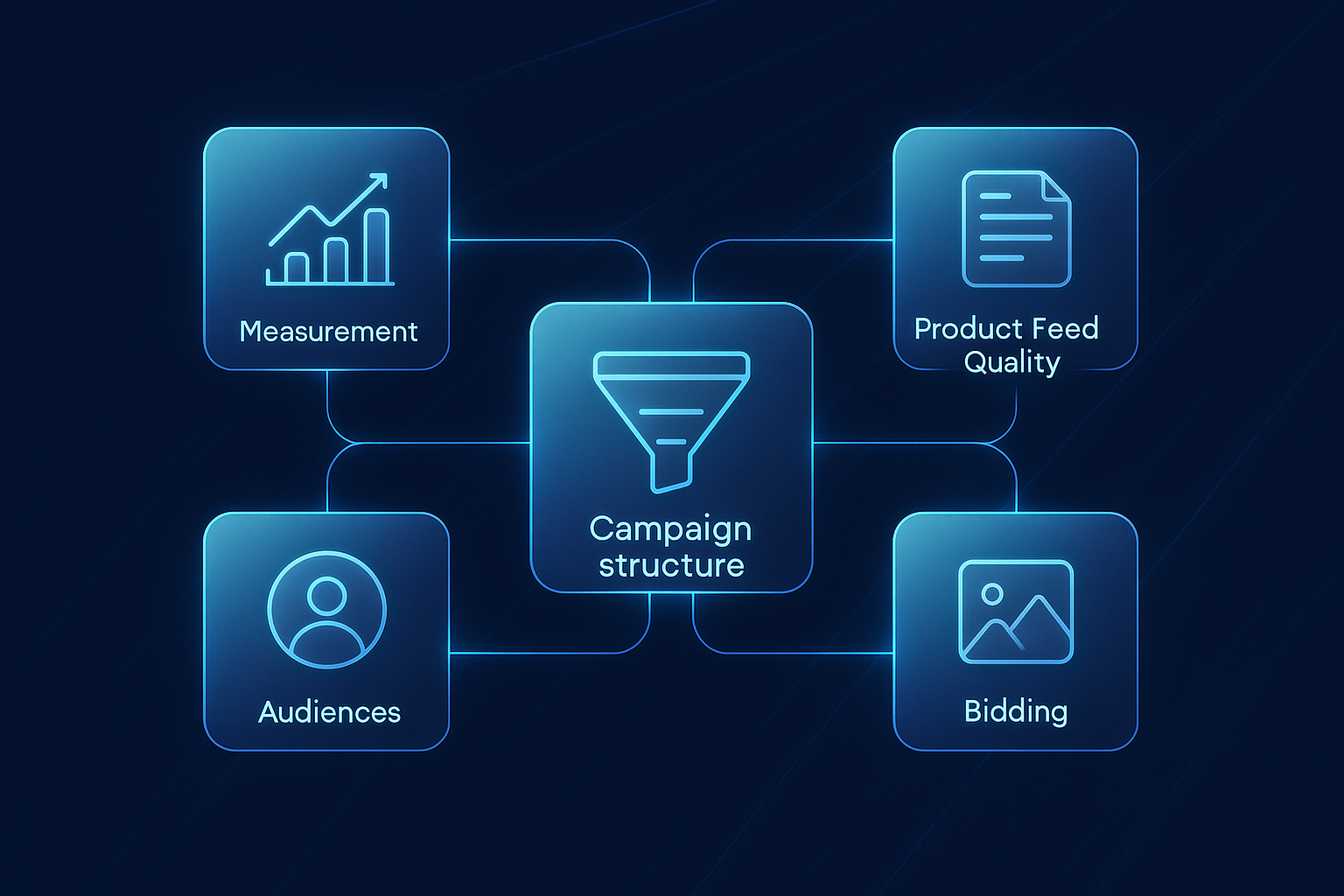
To scale profitably, you must align all six pillars — otherwise ROAS collapses when budgets increase.
| Pillar | Description | Why It Matters for Scaling |
|---|---|---|
| 1. Measurement | GA4 + EC + Server-side + CV | AI cannot scale without high-quality conversion data |
| 2. Structure | Clean, consolidated campaigns | Avoids cannibalization and fights; strengthens signals |
| 3. Feed | Optimized titles, GTINs, images | 60–70% of PMax performance depends on feed quality |
| 4. Audiences | Predictive, in-market, CM | Determines whether Google finds the right buyers |
| 5. Creatives | Videos, images, hooks | Expands reach and improves learning |
| 6. Bidding & Budgets | Gradual increases + profitability tiers | Keeps ROAS stable during scaling |
A single weak pillar can collapse the entire scaling system.
4. Building a Scaling-Ready Account (Complete Blueprint)
Before scaling, you must build an account that is optimized, lean, and signal-rich.
4.1 Fix the Foundation
Measurement Requirements
- GA4 properly linked
- Enhanced Conversions active
- Server-Side tagging implemented
- Consent Mode V2
- 90–100% conversion value accuracy
- A/B testing attribution windows
No measurement → no scale.
Account Structure Requirements
❌ Before:
20–40 campaigns fighting each other
✔ After:
3–6 core campaigns:
- Performance Max (primary scaling engine)
- Search (high-intent support)
- Demand Gen (awareness & expansion)
- YouTube (creative scaling)
4.2 PMax Structure (2025 Version)
Use 4–6 asset groups:
- Brand
- High-Intent Non-Brand
- Bestsellers
- Seasonal Winners
- Competitor-Focused
- Feed-Only Shopping
Audience Signals to Include
- 365-day remarketing
- custom segments containing competitors
- in-market categories
- predictive audiences
- customer match lists (segmented by LTV)
4.3 Search Campaign Structure
- 3 campaigns max
- SKAGs are dead — use themed ad groups
- match types: Exact + Phrase
- negatives updated weekly
Search is your stability anchor.
4.4 Demand Gen + YouTube for Scaling
Demand Gen:
- cheap impressions
- builds remarketing lists
- excellent for high AOV brands
YouTube:
- essential for PMax signal expansion
- ideal for remarketing
- boosts discovery & branded search demand
5. Winning Scaling Tactics for 2025 (Data-Backed)
These tactics are based on real scaling work across 100+ client accounts.
Tactic #1 — Scale Budgets by 20–30% Every 3–5 Days
This prevents:
- learning phase resets
- volume instability
- CPC spikes
Never scale faster unless you’re ready to sacrifice ROAS.
Tactic #2 — Group Products by Profitability, Not Category
Split into profitability tiers:
| Tier | Margin | Bid Strategy | Budget |
|---|---|---|---|
| High | 40–80% | Aggressive | Highest |
| Medium | 20–40% | Moderate | Mid |
| Low | <20% | Conservative | Minimum |
Scaling should prioritize profitable clusters, not all products equally.
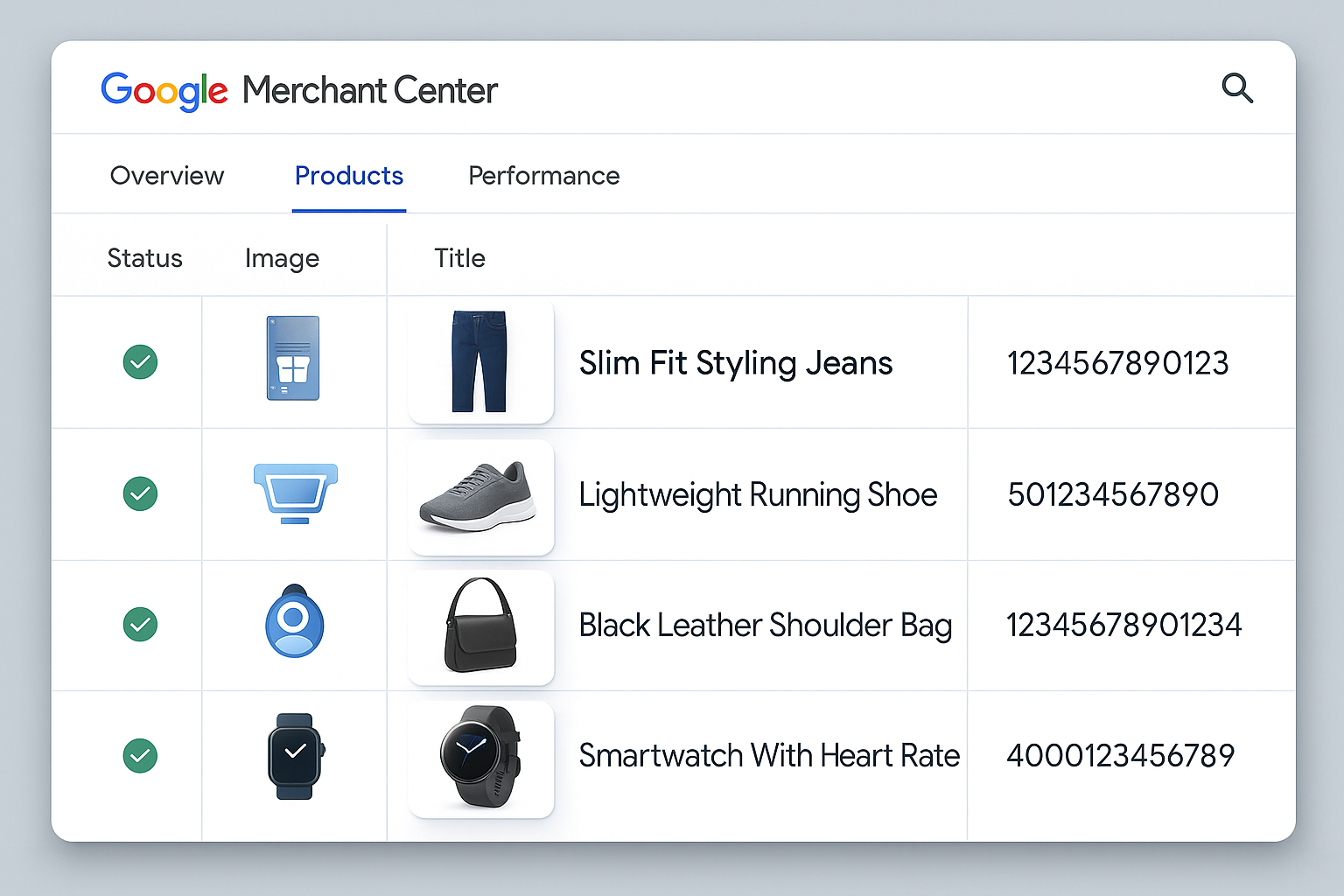
Tactic #3 — Feed-First Scaling (Most Important Tactic of 2025)
Strengthen feed titles with:
- size
- material
- color
- unique quality
- comparison
- intended user
- problem solved
Example Improve Title
❌ “Women’s Boots”
✔ “Women’s Waterproof Leather Hiking Boots – Anti-Slip Winter Outdoor Shoes”
Expect:
- +15–40% CTR
- -10–25% CPC
- +20–60% ROAS increase
Tactic #4 — Asset Group Segmentation for Intent
Google performs better when each asset group has one clear job.
Recommended segmentation:
- Brand
- High Intent
- Competitors
- Funnel Re-engagement
- Bestsellers
- Seasonal Items
- New Arrivals
Tactic #5 — Maintain Strong Impression Share
To scale:
- Search IS > 40%
- Shopping Click Share > 60%
If numbers are lower:
- increase bids 10–15%
- improve feed quality
- add stronger creatives
- reduce campaign fragmentation
Tactic #6 — New Audiences Every 14 Days
Audience expansion increases your “AI surface area.”
Add:
- new in-market categories
- new CM lists
- competitor segments
- interest clusters
- intent-based custom audiences
Tactic #7 — Increase Bids, Not Budgets (High-Intent Search)
Budget increases can destabilize ROAS.
Bid increases maintain intent targeting.
Tactic #8 — Use LTV for Predictable Scaling
Segment Customer Match lists into:
- High LTV
- Medium LTV
- One-time buyers
- Subscription users
This improves:
- modeled conversions
- predictive reach
- bidding accuracy
6. Practical Examples & Case Studies
Case Study 1: eCommerce Brand Scaling 5→40k/month
| Metric | Before | After |
|---|---|---|
| ROAS | 2.4 | 4.1 |
| Revenue | $42k | $190k |
| Monthly Spend | $5,800 | $39,000 |
| Click Share | 37% | 78% |
What changed?
- rebuilt feed
- added 6 asset groups
- improved titles & images
- launched YouTube + Demand Gen
- increased bids slowly
- added high-LTV CM list
Case Study 2: SaaS Lead Gen Brand Scaling (Mid-Market Buyers)
| Metric | Before | After |
|---|---|---|
| CPL | $92 | $43 |
| SQL Rate | 21% | 29% |
| CAC | $843 | $367 |
Changes:
- rebuilt landing pages
- added predictive audiences
- shifted from Max Clicks → Max Conversions
- added competitor Search campaign
7. Scaling Experiments to Run Monthly
| Experiment | Purpose | Good For |
|---|---|---|
| Add new in-market audiences | Expand reach | All |
| Add 1 video asset group | Improve discovery | eCommerce |
| Switch PMax to tROAS | Profit stability | High AOV |
| Launch competitor Search | Capture high intent | SaaS |
| Test feed-only PMax | Improve shopping | Retail |
| Duplicate Search with higher CPCs | Volume expansion | High-intent niches |
8. Avoid These Scaling Mistakes (Most Brands Fail Here)
❌ increasing budgets too fast
❌ poor feed quality
❌ too many campaigns
❌ broken tracking
❌ lack of creative refresh
❌ ignoring impression share
❌ assuming reported ROAS = true ROAS
❌ no profitability segmentation
❌ running PMax without videos
9. The 7-Day Scaling Plan
| Day | Task |
|---|---|
| 1 | Analyze performance + impression share |
| 2 | Update feed titles/images/attributes |
| 3 | Improve one landing page |
| 4 | Scale budgets by 20% |
| 5 | Add new audience signals |
| 6 | Refresh 3 creatives |
| 7 | Add a new asset group |
Repeat weekly for compounding scale.
10. KPIs That Predict Whether You Can Scale Profitably
Track these before scaling:
- MER (Marketing Efficiency Ratio)
- ROAS by product & margin tier
- Click share (critical)
- Modeled conversions %
- AOV trends
- New-to-customer ratio
- Impression share lost to budget
- Impression share lost to rank
These metrics reveal scaling pressure points before ROAS drops.
11. Frequently Asked Questions (2025)
Q1: How much should I increase budgets during scaling?
20–30% every 3–5 days.
Q2: Should I scale PMax or Search first?
Always PMax — Search is stabilizer, PMax is scaler.
Q3: Is broad match good for scaling?
Only if:
- conversion tracking is perfect
- high LTV customers
- strong negatives in place
Q4: How important is video for scaling?
Mandatory. Without video → your PMax can't fully explore.
Q5: How long until scaling stabilizes?
7–21 days depending on budget velocity.
12. Conclusion
Scaling Google Ads profitably in 2025 requires:
- a strong feed
- reliable tracking
- excellent creatives
- profitability segmentation
- audience expansion
- model-aware bidding
- incremental budget changes
Brands that follow this system scale sustainably.
Brands that ignore it burn money.
If you want expert help:
AdProfit.io — Google & Meta Ads Experts (EU & US)
We build, optimize, and scale campaigns that deliver profit, not just traffic.
👉 Book a free audit on our website https://adprofit.io/en/.